Disneyworld and the View-Master

Some Disney themed View-Master reels with a projector and two viewing devices
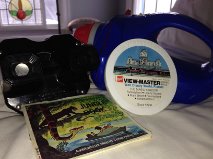
Some Disney themed View-Master reels with a projector and two viewing devices

I never went to Disneyland or the Walt Disney World Resort as a child. In fact, I was not able to go until I was 28 years old, on my honeymoon.  Nevertheless, my mother instilled and then nurtured in me a desire to visit Disneyland.  As a boy she would tell me about Disneyland, take me to Disney movies and adorned my section of the apartment with items of interest that reflected a Disney experience.  Among these items was my collection of View-Master reels.  In the days before home video, you could only see a Disney movie when it was in general release in the theatres or on television if an edited version was featured on The Wonderful World of Disney.  Your other option was to indirectly experience the films through record albums with companion books, comic books, coloring books, and View-Master reels for example. I had all of that stuff and then some, but today I want to focus my attention on the View-Master experience.

View-Master was a modern upgrade of the stereoscopic viewer, a popular form of parlor entertainment dating back to the mid-nineteenth century.  This nifty device was essentially a bulky set of goggles attached to a handle that enabled the viewer to hold the lenses up to their eyes.  Jutting out perpendicular to the lenses was a plane that holds a card baring two identical images.  You view the images through the lenses, which at the right distance created the illusion of an image in three dimensions. The cards would feature a wide variety of subjects  from the pastoral to the urban, the historic to the modern and the innocent to the salacious
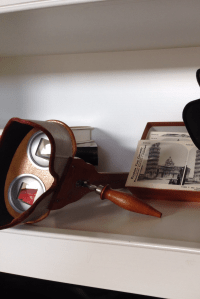
A poorly cropped photo of a stereoscopic viewer with a stereo photo of the Leaning Tower of Pisa in the background.

A poorly cropped photo of a stereoscopic viewer with a stereo photo of the Leaning Tower of Pisa.

Many decades later, View-Master expanded on that concept by creating the familiar rotating discs that would hold seven different color images, and the iconic companion viewing device. A package typically included three reels comprising seven distinct 3-D images for a total of 21 images.  The viewing device had a window displaying a brief description of the corresponding image in the viewer.  Each package also contained a booklet that described the images in greater detail.  That was it; 21 images and a few descriptive words.  Not much, but in a world without home video, they kept the memories of a good movie vivid, moreover, they could connect you with the world and instill a positive sense of longing and anticipation.

I owned many reels inspired from Disney’s classic animated features and cartoon shorts.  For awhile, the manufacturers of View-Master did something interesting with animated films.  Rather than take stills from the actual films, they used the artistic style of the films to craft three dimensional figures and scenery.  These marvelous recreations became the subjects of the photographs used for the reels.  The reasoning behind this approach remains a mystery to me, but the novelty enhanced my enjoyment. I was impressed how detailed the sculptures were, how good the color was, how faithfully they told the story and how well they created the illusion of motion with these images.
GetAttachment (5)

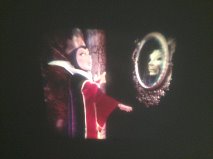
“Slave in the Magic Mirror, who is the fairest?”

“Heigh Ho! ” It’s off to work they go.

One day her prince did come and they all lived happily ever after.

One day her prince did come and they all lived happily ever after.

When I was older, say six or seven, I received a View-Master projector for Christmas.  Now I could project the images onto a wall and turn my apartment into a movie theatre.  On summer nights, I would have public showings of the View-Master versions of Snow White and the Seven Dwarfs, The Jungle Book, Peter Pan and Donald Duck cartoons, while reading aloud the narrative provided in the booklet.  I may have even charged a penny for my efforts, but I provided refreshments.
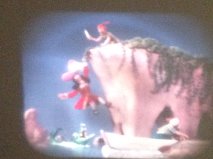
Peter Pan bests Captain Hook. . .again.

Peter Pan bests Captain Hook again.

GetAttachment (4)

King Louie is “monkeying around” with Mowgli

GetAttachment (17)GetAttachmentGetAttachment (16)

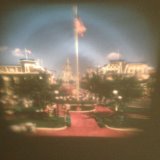
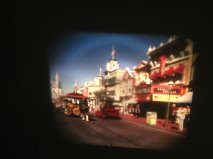
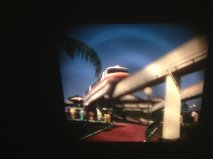
When The Walt Disney World Resort opened in 1971, already a View-Master enthusiast,  I was given a special set comprising five reels, each reel dedicated to one of the themed lands in the Magic Kingdom. I also received another set that had pictures of Disneyland and The Haunted Mansion. All of these reels were my gateway to the Magic Kingdom.  I didn’t casually view these images; I studied them.  They sustained me until I finally got to go some twenty years later. When I arrived at the Magic Kingdom for the first time, it actually felt like I was returning home.  Even though the Magic Kingdom has changed a great deal since it opened.  If I ever want to go back to a time when the cable cars carried you over Fantasyland to Tomorrowland, or take a deep sea voyage on the Nautilus, I need only take out my View-Master reels and the adventure begins.

GetAttachment (8) GetAttachment (9) GetAttachment (10)

The View-Master reels were one of a handful of toys that I saved from my childhood.  When I had children of my own, I rediscovered them and purchased new ones that reflected the movies of the day.  We added Harry Potter, Sesame Street, and Pixar as well as new issues of Disney classic animated films to our collection. On summer nights, just as when I was young, I would use the projector to put on a little show on the wall.

Today’s children can watch professionally created souvenir DVDs that are sold in the parks. They can watch their own high definition home movies. They can also watch You Tube for quality recordings.  They can watch them on a television, or a tablet or a phone with greater resolution than ever before.  These are good things, but in a world of gifs, Instagram posts and ephemeral Snapchat images, there’s something satisfying and calming, especially for young children, in observing a simple image.  The stillness permits, no beckons, one to be drawn into the moment, study a particular image, and savor the beauty.  It may seem counter-intuitive to engage today’s children with such a low tech activity,  but young ones will naturally take to it.  Older children might even try this out of a sense of nostalgia if they experienced View-Masters when they were young.

If you saved your View-Master reels, it’s time to unearth them from wherever they are buried. One evening treat yourself and your family to a slow-paced virtual trip to the Disney theme parks.  If you do, write to us and tell us about your experience.

-Martin Blanco

October, 2015
Upcoming Disney Movies

The Good Dinosaur coming to a theatre near you.

The Good Dinosaur coming to a theatre near you.

You know what’s fun in between visits to Walt Disney World?  Going to see Disney movies.  When possible, we like to go on opening night or sometimes on secret early screenings just before opening night.  For the last several years, we’ve been going with friends to the secret early openings for the summer Pixar film.  These openings usually occur around the last day of school so it’s a fun way to kick of summer vacation. This year with Inside Out, we were able to see a special behind the scenes tour of Pixar Studios and a live interview with Amy Poehler at the end of the film.  They also gave away a poster and lanyard.

Here are release dates for the next year or so.  Good news:  the dates are set for all 3 new Star Wars films and for the highly anticipated Toy Story 4.

Upcoming Disney Movie release dates.

These could change and we’ll try to update them.

Finding Dory (Pixar)   Release Date: June 17, 2016

The BFG (Walt Disney Pictures)   Release Date: July 1, 2016

Pete’s Dragon (Walt Disney Pictures)   Release Date: August 12, 2016

Doctor Strange (Marvel)   Release Date: November 4, 2016

Moana (Walt Disney Animation Studios)   Release Date: November 23, 2016

Star Wars Anthology: Rogue One (Lucasfilm)   Release Date: December 16, 2016

Beauty and the Beast (Walt Disney Pictures)   Release Date: March 17, 2017

Guardians of the Galaxy 2 (Marvel)   Release Date: May 5, 2017

Star Wars: Episode VIII (Lucasfilm)   Release Date: May 26, 2017

Toy Story 4 (Pixar)   Release Date: June 15, 2018

Coco (Pixar)   Release Date: November 22, 2017

Cars 3 (Pixar)   Release Date: June 16, 2017

Incredibles 2   Release Date: June 21, 2019

Pirates of the Caribbean: Dead Men Tell No Tales (Walt Disney Pictures)   Release Date: July 17, 2017

-Matt

Here is a link to the trailer for The Good Dinosaur  https://www.youtube.com/watch?v=R1nfAxkpx9M

c.2015

Pick up and Read: Peter Pan

IMG_3717 (2)

Walt Disney released his animated film Peter Pan in 1953.  Already a beloved story with a variety of adaptations in print, on stage, and even on film, Disney’s take on this relatively young classic quickly earned a prominent place in the canon of Peter Pan lore.  Two years later, the movie was the inspiration for the Peter Pan’s Flight ride at Disneyland which was one of the few attractions that were operational on opening day. Sixty plus years later, the Disney film and theme park attraction remain as popular as ever.  We all know that on any given day, people will wait close to two hours in Fantasyland to take a ship ride in the midnight sky from London to Neverland.

There are new stories about Peter Pan being written. New movies and plays as well as revivals of old favorites are being produced.   There is a bus company that bears the name Peter Pan as well as a popular brand of peanut butter who’s marketing campaign equates our “belief” in peanut butter with the “belief” in Peter Pan.  We are culturally awash in Peter Pan, but how many of us have actually read it?  If you haven’t, put it on your list of family books to read.  I’m not suggesting you read any of  the editions adapted from the Disney film although that can be fun too.  Rather, I am suggesting that you read J.M. Barrie’s original, unabridged  story.

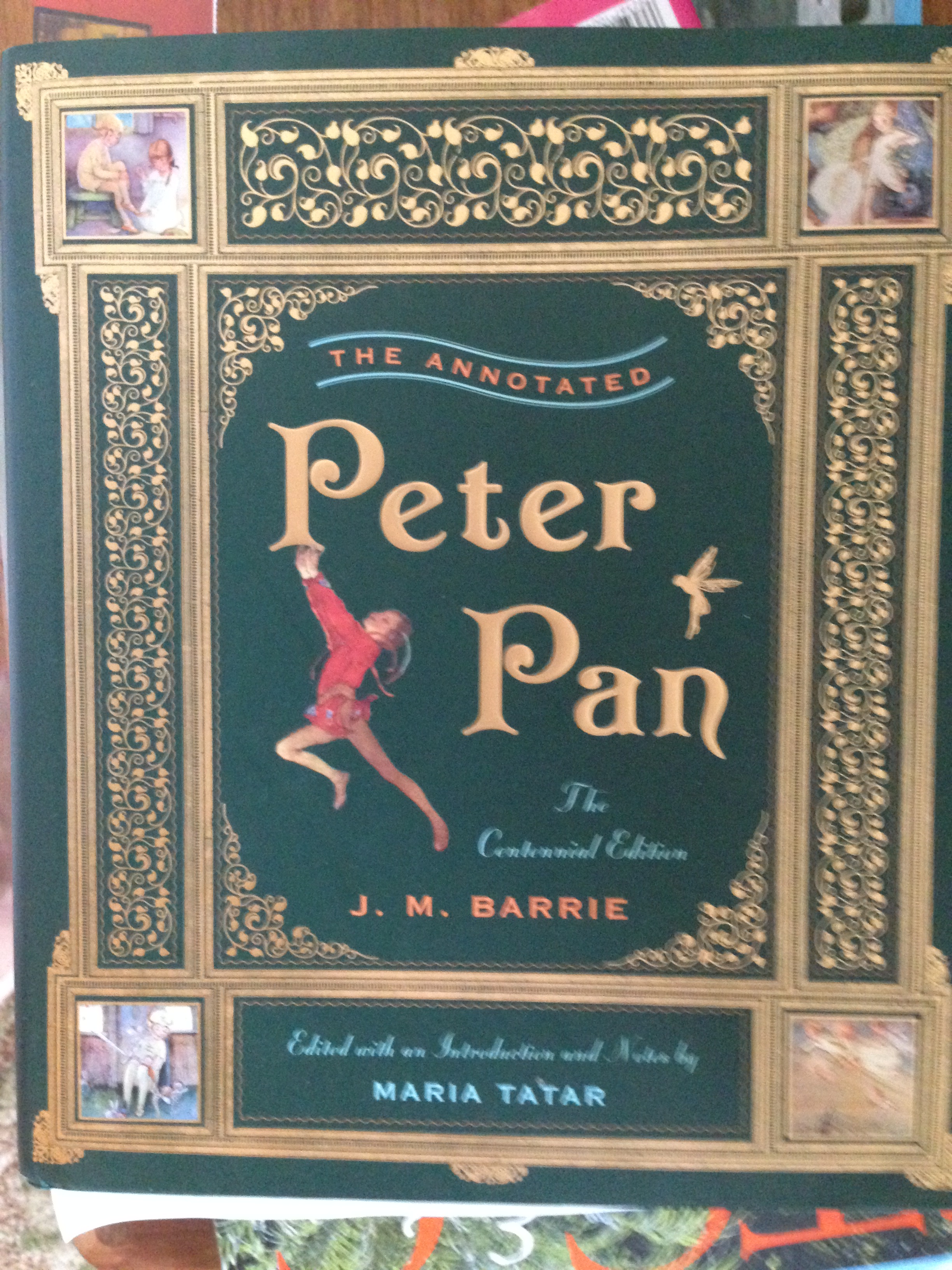
If you don’t already own a copy, your local library will have one or you can purchase one on a kindle device for less than five dollars.  Of particular interest to me is The Annotated Peter Pan – The Centennial Edition edited with an introduction and notes by Maria Tatar and published by W. W. Norton and Company.  Any good annotated edition will have an abundance of notes which define antiquated terms, explain customs and allusions that would be unknown to us today, and discuss themes, style, and imagery.  This edition also has biographical information, a detailed history of the literary development of Peter Pan and beautiful illustrations from varied sources including all the pen and ink drawings rendered by F. D. Bedford for the original 1911 publication.  It retails for about $40, but I found three copies on sale at an independent bookstore for $10.  I purchased all three , gave one to my son, and gifted the others to friends who love Peter Pan.  You can probably find copies online for less than retail, but had I paid $39.95 for it, I would not have felt ill-used.

At the time of publication in 2011, editor Maria Tatar was teaching courses on literature and folklore at Harvard University where she had served as dean for the humanities.  In addition to the text and illustrations, Tatar meticulously chronicles Barrie’s development of Peter Pan from secondary character in a novel to lead player in his own story.  She notes that the character Peter Pan debuted in Barrie’s novel of 1902 The Little White Bird.  In this novel, Peter Pan is a seven day old boy who has a number of adventures in Kensington Gardens.  Those adventures were subsequently published separately in 1906 under the title Peter Pan in Kensington Gardens.

In between these offerings, Barrie wrote a play which premiered in 1904 called Peter Pan or The Boy Who Would Not Grow Up.  While the play enjoyed popular productions for years, it was not published until 1928.  Tatar notes that during that time, the script underwent many revisions by Barrie.  Happily, Peter Pan’s development did not end on the stage.  In 1911 Barrie published Peter and Wendy, which in time would be renamed Peter Pan. Ms. Tatar writes that many of his early scripts “are preserved in the J. M. Barrie archive at [Yale University’s] Beinecke Rare Book and Manuscript Library in New Haven, Connecticut where the bulk of Barrie’s papers are stored.”

After reading The Centennial Edition. . ., I had a little adventure of my own, which brought me very close, literally, to J. M. Barrie’s masterpiece. There is another part of the Peter Pan legacy that resides at Yale.  Before Barrie wrote any of the Peter Pan stories, he published a scrapbook of sorts chronicling the adventures he had one summer with Arthur Llewelyn Davies and his three sons.  In 1901, the Davies family was vacationing close to where Barrie and his wife were also on holiday.  Barrie was taking a break after toiling on a play called Quality Street, which was being produced in America by the great (if not infamous) theatre owner and producer Charles Frohman.

Barrie and the Llewelyn boys had numerous pretend “adventures” that summer which Barrie lovingly photographed.  These included a shipwreck, wicked pirates and tiger hunts.  These boyish frolics would eventually manifest in Barrie’s Neverland.  Meanwhile, Barrie’s scrapbook included a number of captioned photographs of their adventures.  He went on to publish two copies, crediting Llewelyn Davies’ son Peter with authorship, and himself only as a publisher.  Maria Tatar includes a reproduction of this book in  The Centennial Edition and writes that this work “offers us the first real glimpse of Peter Pan. With its lost boys and savage pirate captain, its protective dog watching over sleeping children, and its mysterious boy described as ‘the sly one, the chief figure, who draws farther and farther into the wood as we advance upon him’ it is the . . .book that gave birth to the boy who would not grow up.”

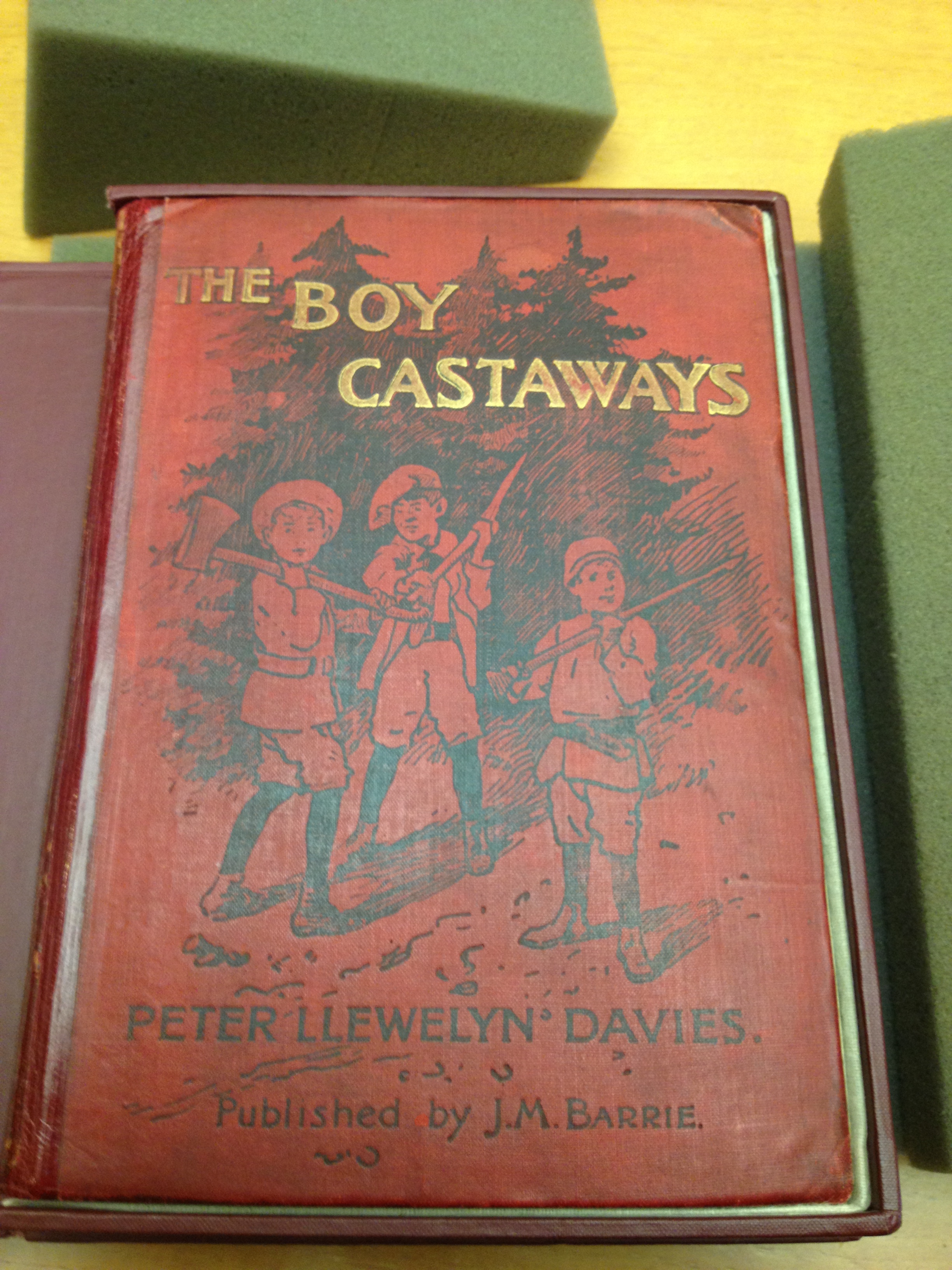
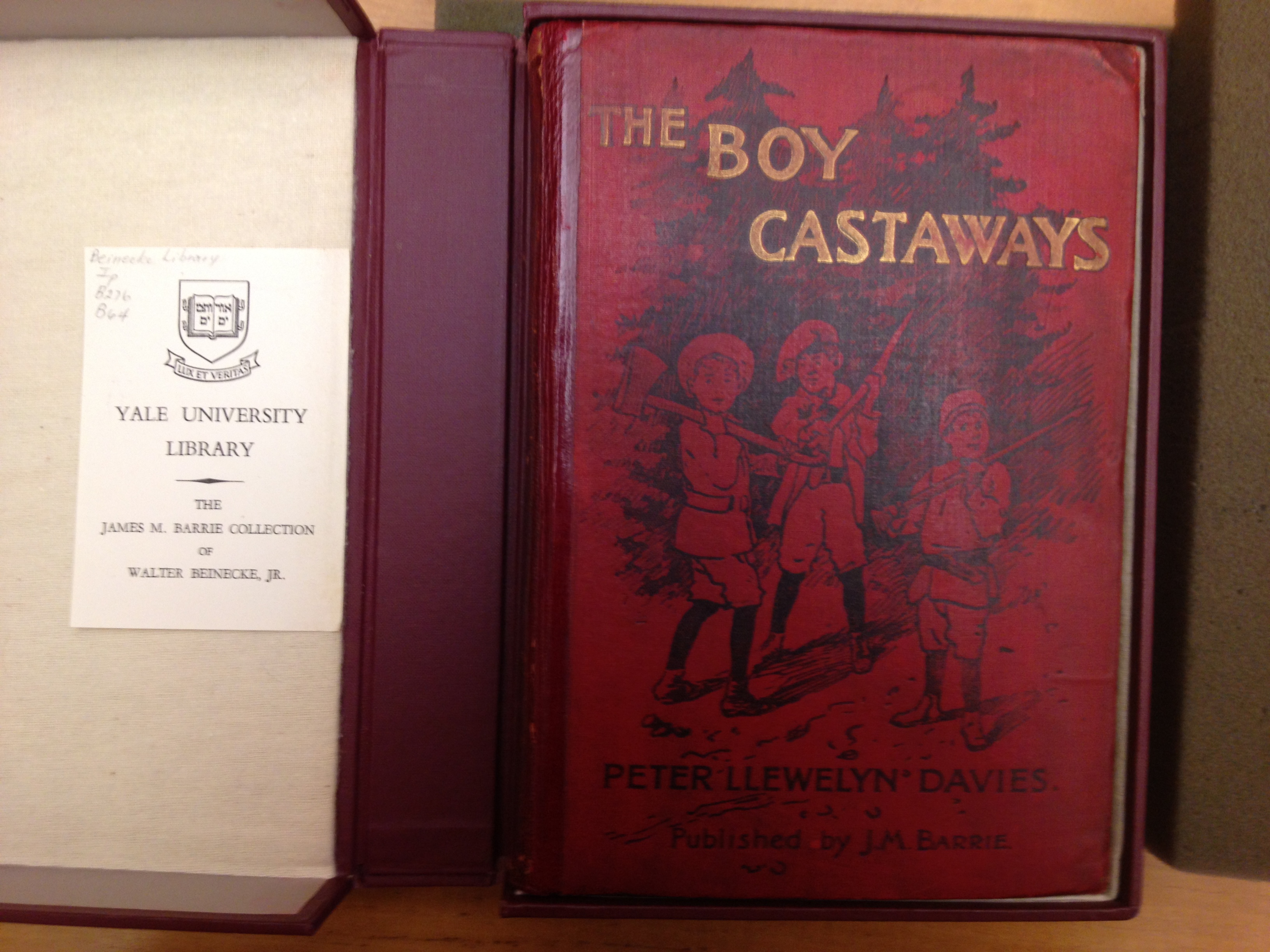
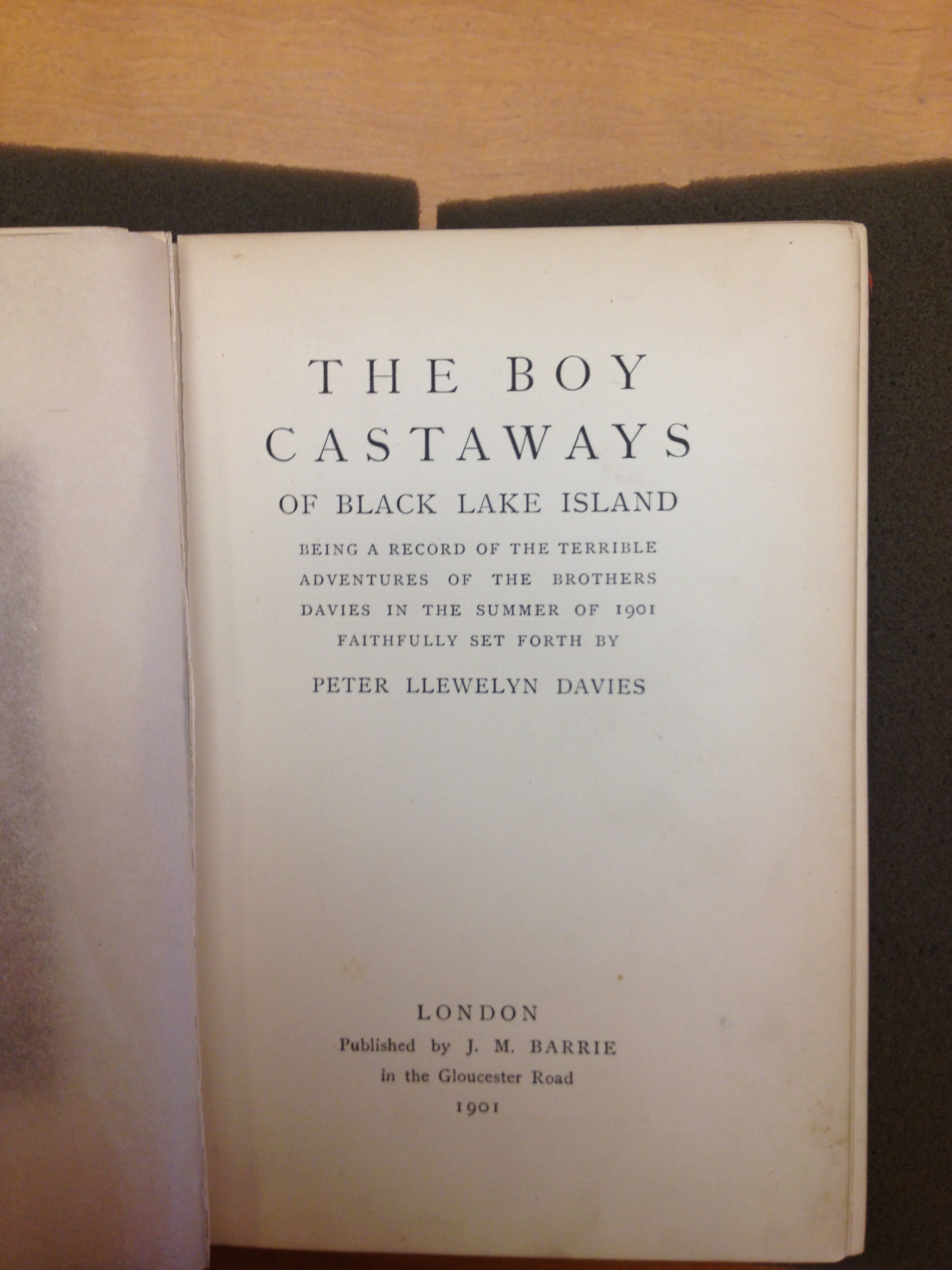
The full title of this book is The Boy Castaways of Black Lake Island, being a record of the terrible adventures of the brothers Davies in the Summer of 1901, faithfully set forth by Peter Llewelyn Davies.  One copy was given to Arthur Llewelyn Davies.  He claims to have lost it on a train.  The sole remaining copy resides in Yale’s Beinecke Rare Book and Manuscript Library.

I live in Connecticut, not terribly far from New Haven.  About a year ago, I found myself in New Haven with a couple of hours to kill so I visited the Beinecke and asked if I could see The Boy Castaways of Black Lake Island.  Anyone can view materials at the Beinecke. You need to have two forms of photo identification and you must leave coats, bags, folders, writing instruments and any object that might plausibly be used for theft or destruction, in a locker. Had I planned my visit, I could have registered online, but the librarians helped me do that onsite. Within ten minutes of my request, they brought me The Boy Castaways. . . .

The book is stored in an archival quality box. I was given the box, the book and three pieces of foam on which to rest the book. I was then invited to enter the Reading Room where I spent a half hour with this literary treasure.

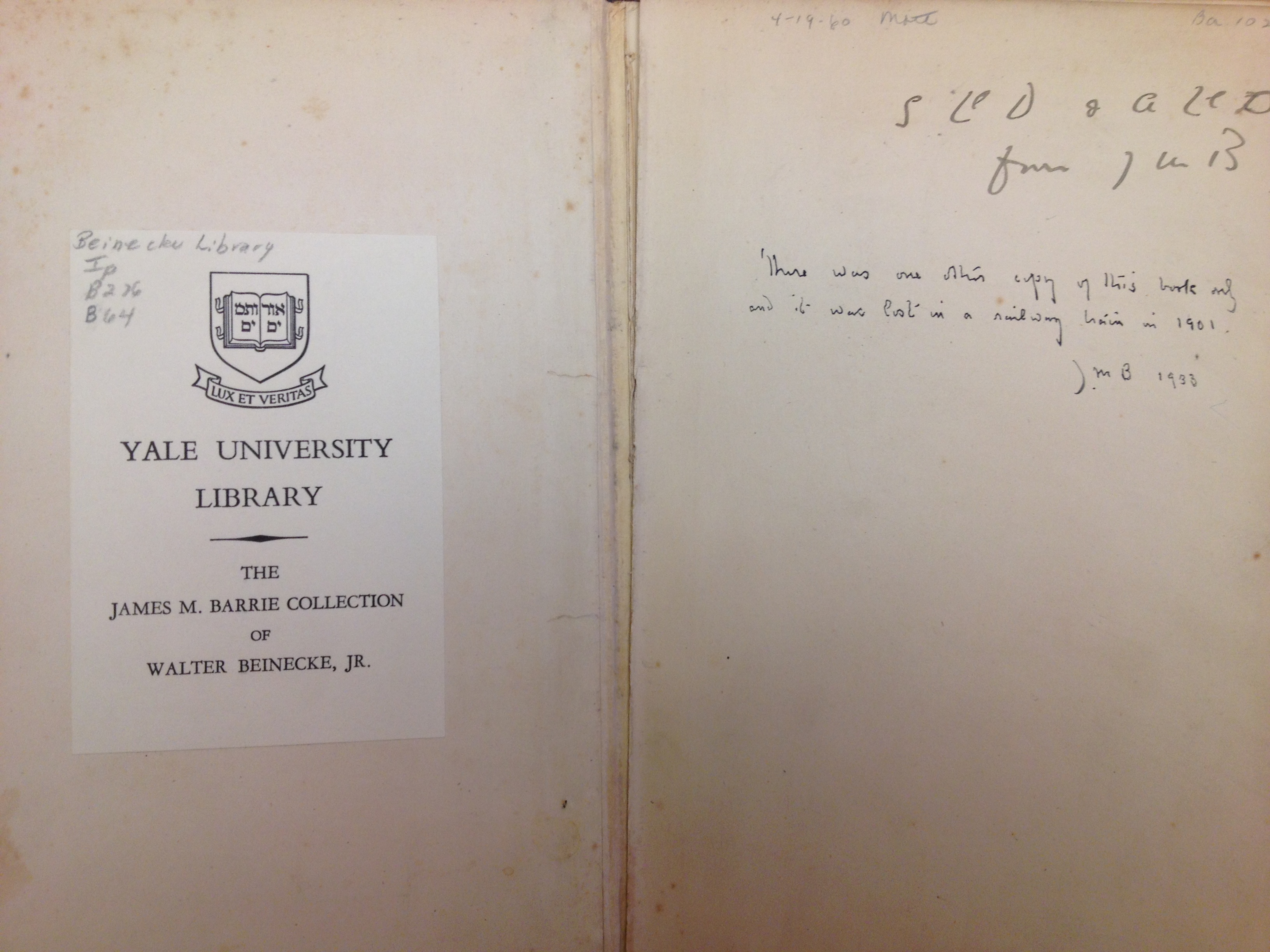
The cover was a handsome deep maroon color.  One of the front papers had a note signed by J. M. Barrie himself: “There was one other copy of this book only and it was lost in a railway train in 1901. J M B 1933.”  The photos were in excellent condition and conveyed the sense of whimsical adventure of the Davies brothers that summer.  It was terribly exciting for me to hold and peruse this extraordinary relic from the world of Peter Pan.  It seemed so new even though it was fashioned five years before my grandmother was born. For a few brief minutes, I felt like I was part of the legacy of Peter Pan.

If you might be inclined to examine The Boy Castaways. . ., assorted ephemera related to Peter Pan or any of J. M. Barrie’s papers, the Beinecke Library will welcome you.  I should warn you though, that the Beinecke Library is closed for renovations until fall 2016.  Meanwhile, before you leave for your next trip to the Walt Disney World Resort, go read Peter Pan.

The Boy Castaways. . .

The Boy Castaways. . .

IMG_1346 (2)

IMG_1348 (2)

notice the signature: J M B

IMG_1349 (2)

The Boy Castaways. . .at rest at the Beinecki Library at Yale University

The Boy Castaways. . .at rest at the Beinecke Library at Yale University

story and photos by Martin Blanco

September 2015

The AMRICAN EXPERIENCE on PBS to feature Walt Disney

On September 14 and 15, PBS will feature Walt Disney on The American Experience.  This four hour documentary will feature an in depth study of Walt Disney and feature rare photos and footage from his personal and professional life.

Check your local PBS station for broadcast times.

The American Experience is an excellent show and this a must see for any Disney devotee.

http://www.pbs.org/wgbh/americanexperience/blog/2015/7/30/why-we-made-walt-Disney/

walt disney

Reading the Disney Stories

One way we manage to keep the spirit of Disney World with us at home, is by reading the original stories that inspired the classic films, both animated and live action. Reading together remains a part of our regular family activities, and reading the original stories of beloved Disney films has been most rewarding. Reading these books has kept the joy of our vacations going strong at home, and has introduced the children to many classics of Western Literature at a tender age.
I studied  English and theatre with an emphasis on western dramatic literature (western as in European and American, not cowboys and cattle). From time to time I would encounter professors who were critical of the work of the Walt Disney Studios. Their chief complaint was that when Walt Disney adapts a story he fundamentally sacrifices literature for populist appeal. While I understand their point, I don’t embrace it. Animated film is not literature and a Disney film is not obliged to be a slave to its primary source. Walt Disney took great liberties with stories for populist appeal, but he also transformed them into distinctive works of art frequently with more lasting value than their source. By the way, William Shakespeare did the same thing; it is the nature of creative arts.
When people think of Snow White today, their first thought is of the Disney film. Snow White was first published by the Brothers Grimm in 1812 in their famous book of fairy tales, and this anthology was itself a compendium of folk tales derived from the oral tradition. There is something about Snow White that has historically captured our imagination and before Disney made his landmark film, there were two silent films adapted from Grimms’ Snow White, one released in 1902 and another, which was beloved by Walt Disney himself, in 1916. There was also a sound version in 1933 featuring the cartoon character Betty Boop as Snow White. In 1912 there was a theatrical version produced on Broadway. This production marks the first time the dwarfs were given names: Blick, Flick, Glick, Snick, Plick, Whick, and Quee.

The Disney film was a pioneering technical achievement for animated motion pictures. It is suffused with much artistry and has endured for more than 80 years as the definitive version. So if Walt Disney took liberties with the original story, the extensive artistry of the animation, the brilliant ingenuity in the process, and the compelling storytelling, more than compensates for the dilution of the literature.
There is another important consideration that some scholars and the general public ignore and one that has inspired me to write this post. After you see and presumably enjoy a Disney animated film, that experience is the gateway to further literary exploration. After seeing Snow White and the Seven Dwarfs one is curious about the tale as told by the Brothers Grimm. After seeing Disney’s adaptation of The Jungle Book, one might be inspired to read Kipling’s The Jungle Book. After reading the original story, one might be inspired to read more of Kipling. This holds true for many of the classic Disney films and I invite you and your family to explore these works more deeply. I believe the journey will be rewarding.

-Martin Blanco

An old print from a Brothers Grimm edition of Snow White reprinted in The Annotated Brothers Grimm edited by Maria Tatar.

An old print from a Brothers Grimm edition of Snow White reprinted in The Annotated Brothers Grimm edited by Maria Tatar.

the Brothers Grim cover website photo

c. 2015